I do not know the date or place of death for Jeremiah ‘Darby’ O’Brien in Australia. When I find it, I am hoping to find his mother’s name which will provide clues to finding our ancestors in County Clare, Ireland. The transcript of his wife Letitia’s death certificate informs us that her husband Jeremiah/Darby was deceased at the time of her death in Sydney 1889. The informant was Letitia’s son-in-law J. Cavanagh who may not have known his father-in-law and either he or the transcriber of the death certificate has made an error with Jeremiah’s christian name, recording it as James. According to Killaloe Parish Marriage Records, Darby O’Brien, residing in Knockadereen married (widow) , Letitia Roach/Roche (widow Crotty residing in Parish of Abington) in 1833. Catholic Parish Registers for the Diocese of Killaloe (1655-1915) record the Baptism of their child Fanny on 1 June 1834. The family residence is noted as Knockadereen (one of the townlands in the Parish of Killaloe). The Baptism sponsors were Biddy O’Brien and John Scanlan both from Garraunboy/Garrenboy/Gerrenboy/Geranboy, County Clare. Perhaps Biddy (short for Bridget) is Jeremiah’s sister? Thanks to the helpful members of the County Clare Ireland Genealogy Facebook Group who suggested I look at the Tithe Applotment Books (Irish National Archives), I found a Darby O’Brien listed as a Knockadereen landholder in 1828 in partnership with Dennis McKeough. If this is our Darby, could his mother be related to the McKeoughs? It is likely that the eldest daughter Maria, was born of her mother Letitia’s previous marriage to William Crotty. Finding Jeremiah’s parents is proving to be very difficult. I have found death and marriage records for all of Jeremiah and Letitia O’Brien’s daughters in Australia (more information to be eventually added to this blog) and they have provided clues as to the occupation of Jeremiah O’Brien. His youngest daughter Anna Matilda O’Brien, seamstress (1842 -1915) married William Graham (signwriter) in Fitzroy Victoria in 1867. On the marriage certificate, her father Jeremiah O’Brien’s occupation is listed as Contractor.
Category: O’Brien
Letitia O’Brien (Roche)
Letitia’s parents were Letitia (Burke) and Nicholas Roche of Vauchluce/Vauclause situated in Glenstall Woods on the Limerick side of the Limerick Tipperary border. Letitia’s father Nicholas is described as an Architect in Letitia O’Brien’s immigration papers but I have not been able to find any evidence of his qualifications or work in Ireland. When Letitia O’ Brien’ s mother died, Letitia’s brother, Edward Burke Roche inherited the premises and lands consisting of 470 acres. Prior to emigrating to Australia in 1834, Edward Roche sold the property to the Barrington family from Dublin, who had already been renting a portion of the lands. The Barrington family built a copy of a 12th century (Windsor Castle style) castle as their home, using the Roche family home Vachluce/Vaucluse as a hunting lodge (now in ruins). The nearby village of Murroe was founded to serve the needs of the Barrington Estate. It is possible to see the ruins of our ‘ancestral home’ Vauchluce by following a popular walking trail (The Slieve Felim Way) that starts from the village of Murroe. The Barrington family moved to England in the 1920s and sold their ‘castle’ and lands to a Benedictine Order. Today, the Benedictines of Glenstal Abbey run a farm and boarding school. They also offer accommodation for guests – there are very good descriptions and reviews on Trip Advisor ‘Glenstal Abbey’. My plea (on this blog) for photos of the Vaucluse ruins was answered by the wonderful Pat McCormack who went for a hike to take some photos for me. I have been very tardy in adding these photos to the blog – sorry Pat and thanks again!

Walk no. 26 The Slieve Felim Way.


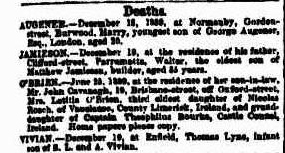
Letitia O’Brien died 25 June 1889 at the home of her daughter Letitia and son-in-law John Cavanagh, 19 Brisbane St, Sydney, at the age of 85. Her death notice in the Sydney Morning Herald names her father Nicholas Roach of Vauclause, County Limerick and names her (maternal) grandfather Captain Theophilus (Theobald) Bourke of Castle Connell, County Limerick, (near the boundaries of Counties Clare and Tipperary), Ireland. The Bourke connections and intermarriages with the Roches go back for centuries in Ireland (worthy of another post!) and that’s why Letitia’s grandfather Theobald/Theophilus Burke is mentioned in Letitia’s death notice. I have already mentioned that Letitia’s brother Edward Roche married his first cousin Maria Bourke (related to Sir Richard Bourke ex-Governor of NSW). Contrary to my opening statements about the ‘poor O’Briens’, I have since found evidence that Jeremiah and Letitia O’Brien made the most of their distant familial connections with Sir Richard Bourke on their arrival in Sydney (see post to follow on daughter Fanny O’Brien). The transcript of Letitia’s death names all of her daughters except for Bridget (more on her later – she went to Queensland and died in 1892 at Springsure).

Please note possible transcription error above regarding the name of Letitia’s husband Jeremiah. The abbreviation for James and Jeremiah can look similar in unclear handwriting.
Frances O’Brien (1834 -1927)

See entry 1507
My great- great -grandmother Fanny O’Brien (see above entry 1507 in the Catholic Parish Registers Diocese of Killaloe, County Clare, Ireland) was baptised 1 June 1834. Her parents Darby and Letice (Roche) of Knockadereen and sponsors John Scanlan and Biddy O’Brien of (nearby) Garenboy were present. You already know that she arrived in Sydney with her parents and 3 sisters, Maria, Bridget and Letitia, at the age of 5, in March 1839. When she was 16 she married William Hubbard (Hubberd/Hubbert) (overseer of Tenterfield Station) on 6 August, 1850. William Hubbard was the Australian born son of First Fleeter convict and later Sydney Constable and Waterman (William Hubbard Senior) and his second wife (convict) Hannah Whitelock/Whitlock.

http://nla.gov.au/nla.news-article115765616
The NSW Register of Births records 5 children from this union: First there was William Hubbard (birth registered in Gundagai as William Hubbart) in 1853. The next registered births were Jeremiah F. Hubbard 1862, Letitia A. Hubbard 1865, Emma M. Hubbard, 1867 and there was another daughter Frances Elizabeth Hubbard (married and divorced Peter Ryan and later married Andrew Crawley) but I haven’t found her birth registration. Then on 4 June 1869 my great-grand-father Henry Charles Hubbard was born at Barrigan in the Mudgee district. I need to do more research but it’s possible that Fanny and her then 15 year old eldest son William found work on Barrigan Station at the end of 1868, through necessity after her husband William Hubbard died in Inverell Hospital, NSW on 27 May, 1868. His death certificate states that death was due to a 6 week illness caused by bronchitis. Henry Charles Hubbard’s name later changed to Gardener when his mother married George Gardener in 1869. Henry Charles was given the Hubbard name at birth but he could not have been William Hubbard’s son as he was born on 4 June 1869, just over 12 months after William Hubbard’s death. Was George Gardener from Somerton his father? We can’t be certain about that – more details to follow in a separate post on Henry Charles Gardener. And now, a real surprise – genealogical gold in the form of a newspaper article reporting on the ”97th” birthday celebrations in Darlington Sydney, of Frances (Fanny) Gardiner (Hubbard)! Via the reporter, Frances herself gives us a snapshot summary of her whole life, just one month before her death in August 1927. Most importantly, the article confirms that the O’Briens did make use of family connections on their arrival in Sydney in 1839. For several years, they lived (and most likely worked) at Barham, Darlinghurst, at the home of the Colonial Secretary Sir Edward Deas Thomson, who was married to Anne Maria Bourke (second daughter of ex-Governor of NSW Sir Richard Bourke) to whom Letitia O’Brien was distantly related. Remember that Letitia’s brother Edward Roche married his first cousin Maria Theresa Bourke (a second cousin of Sir Richard Bourke). I am interested to know how these connections to the ex-Governor of NSW and to the Colonial Secretary assisted our ancestors however it seems that Sir Richard Bourke also helped many immigrants (unrelated to him) to find work. After his death, there was widespread acknowledgment of his kindness and empathy for immigrants looking for work in the Colony. He would personally write to potential employers to recommend people for work. Let’s enjoy this amazing newspaper article (see below). Frances/Fanny O’Brien/Hubbard/ Gardiner describes some lively events that she experienced in her lifetime. The digitised newspaper article is in pretty poor shape so I have made a transcript for easier reading – see transcript in bold below the article.
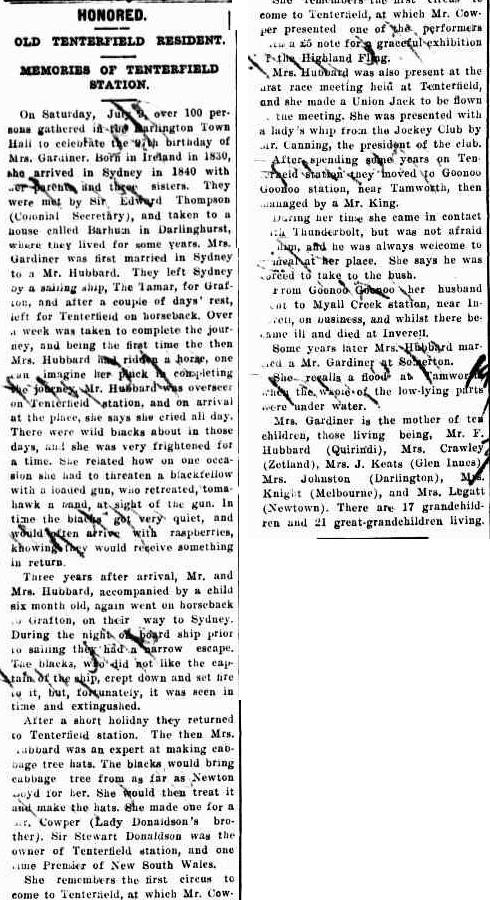
Fri 29 Jul 1927
Page 4
http://nla.gov.au/nla.news-article121422573
”On Saturday, July 9, over 100 persons gathered in the Darlington Town Hall to celebrate the 97th birthday of Mrs Gardiner. Born in Ireland in 1830, she arrived in Sydney in 1840 with her parents and three sisters. They were met by Sir Edward Thompson (Colonial Secretary), and taken to a house called Barham in Darlinghurst, where they lived for some years. Mrs Gardiner was first married in Sydney to a Mr Hubbard. They left Sydney by a sailing ship, The Tamar, for Grafton, and after a couple of days rest, left for Tenterfield on horseback. Over a week was taken to complete the journey, and being the first time the then Mrs Hubbard had ridden a horse, one can imagine her pluck in completing the journey. Mr Hubbard was overseer on Tenterfield Station, and on arrival at the place, she says she cried all day. There were wild blacks about in those days, and she was very frightened for a time. she related how on one occasion she had to threaten a blackfellow with a loaded gun, who retreated, tomahawk in hand, at sight of the gun. In time the blacks got very quiet, and would often arrive with raspberries, knowing they would receive something in return.
Three years after arrival, Mr and Mrs Hubbard, accompanied by a child six months old, again went on horseback to Grafton, on their way to Sydney. During the night on board ship prior to sailing they had a narrow escape. The blacks who did not like the Captain of the ship, crept down and set fire to it, but fortunately, it was seen in time and extinguished.
After a short holiday they returned to Tenterfield Station. The then Mrs Hubbard was an expert at making cabbage tree hats. The blacks would bring cabbage tree from as far as Newton Boyd for her. She would then treat it and make the hats. She made one for a Mr Cowper (Lady Donaldson’e brother). Sir Stewart Donaldson was the owner of Tenterfield Station, and one time Premier of New South Wales. She remembers the first circus to come to Tenterfield, at which Mr Cowper presented one of the performers with a 5 pound note for a graceful exhibition of the Highland Fling. Mrs Hubbard was also present at the first race meeting held at Tenterfield, and she made a Union Jack to be flown at the meeting. She was presented with a lady’s whip from the Jockey Club by Mr Canning, the president of the club.
After spending some years on Tenterfield Station they moved to Goonoo Goonoo Station, near Tamworth, then managed by a Mr King. During her time she came in contact with Thunderbolt, but was not afraid of him, and he was always welcome to a meal at her place. She says he was forced to take to the bush. From Goonoo Goonoo her husband was sent to Myall Creek Station, near Inverell, on business, and whilst there became ill and died at Inverell.
Some years later Mrs Hubbard married a Mr Gardiner at Somerton. She recalls a flood at Tamworth when the water of the low-lying parts were under water. Mrs Gardiner is the mother of 10 children, those living being, Mr F. Hubbard (Quirindi), Mrs Crawley (Zetland), Mrs J.Keats (Glen Innes), Mrs Johnstone (Darlington), Mrs Knight (Melbourne), and Mrs Legatt (Newtown). There are 17 grandchildren and 21 great-grandchildren living. ”
I found another newspaper article (see below) about our Frances O’Brien’s 97th birthday party. It records much the same information as the above article including her meeting with Thunderbolt and her arrival in Sydney in 1840 as a child, with her family, being met by the Colonial Secretary and his wife Lady Thompson (a daughter of ex-Governor Bourke) ‘who drove them by carriage to a home in Darlinghurst.’ The new information pertains to Fanny’s father, Jeremiah O’Brien who the article records ‘was a stonemason by trade, and took his contract of church building from Bishop Broughton of the Church of England.’ It’s possible that Jeremiah worked on the St Andrew’s Cathedral in George St, Sydney but also likely that he worked on other church buildings in regional NSW or further afield in Victoria, where two of his daughters (Maria and Anna) settled after marriage. I am still looking for Jeremiah’s record of death and/or grave so perhaps Jeremiah’s work on Church building projects, is an important clue pointing to his possible departure from Sydney (and his wife) and could explain why there is no acknowledgement of him (dead or alive) at the time of his wife’s death in Sydney in 1889, in her death or funeral notices. Jeremiah’s immigration record states that he was a farm servant. As there was a need for agricultural workers, perhaps Jeremiah found it easier to immigrate under an agricultural classification and then reverted to his true trade as soon as he was able to find work?

Understandably, newspaper reports of Fanny’s 97th birthday highlighted the most exciting events in her life. I found a much earlier (1868) newspaper article which describes a very sad scenario. By the end of 1868, Fanny was widowed with 5 children and expecting our great -grandfather, Henry Charles, when she fronted Armidale Police Court on 1st December with a desperate request to surrender her children to an institution because she could no longer support them. Her request was denied because the Court determined that she was a woman able to work. Furthermore, her 15 year old son was deemed capable of working to support the family because he was accustomed to station work. See 3rd paragraph below.

http://nla.gov.au/nla.news-article187999393
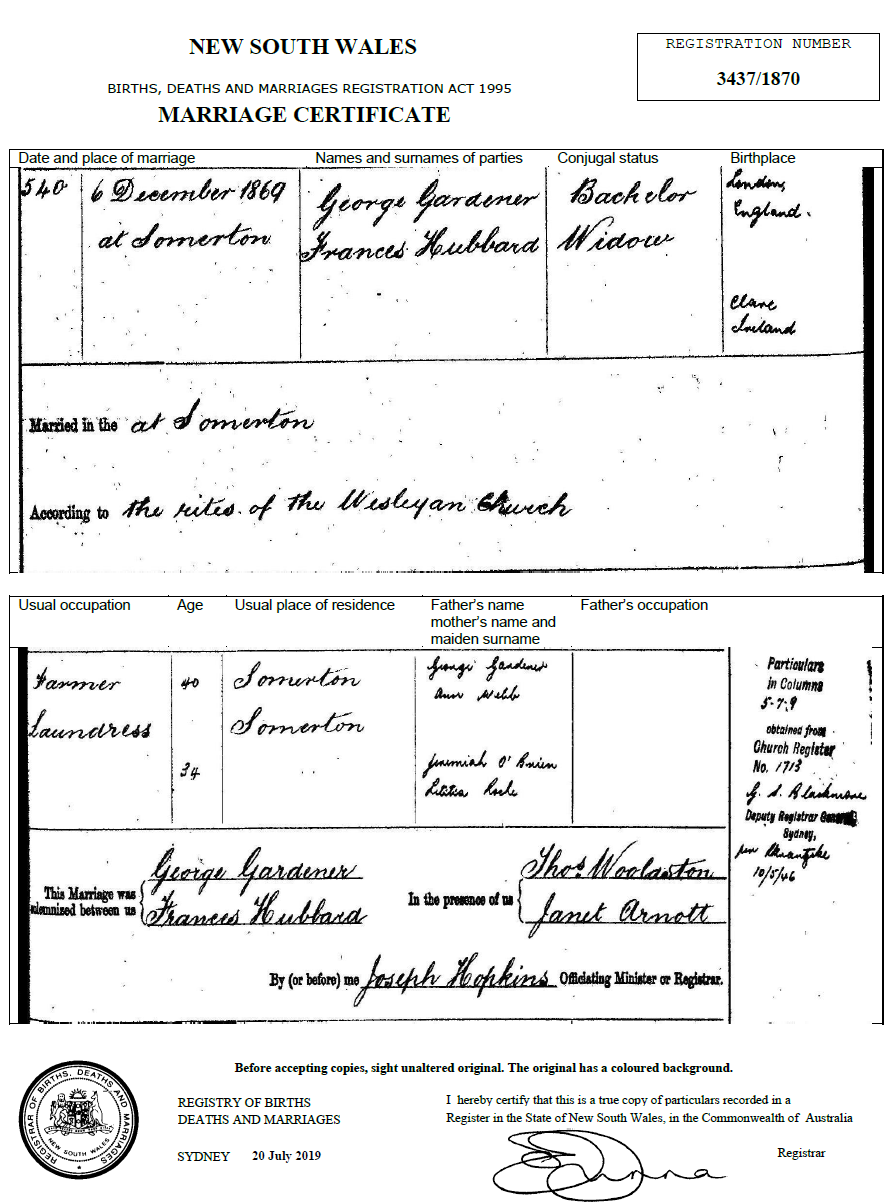
One year after her Armidale Court appearance and six months after the birth of Henry Charles Hubbard, Fanny married George Gardener from Somerton (about 38 km from Tamworth) on 6 December 1869. See Marriage certificate below. George Gardener was a landowner and farmer in Somerton, selecting his small block in 1859.
It is interesting to note that Fanny does not mention her son Henry Charles (my great-grandfather) when she lists her living descendants at her 97th birthday celebrations. NSW Register of Births records the registration of 4 births to George and Frances Gardener. They were Matilda C. Gardiner in 1871, Florence Gardener in 1874, George O’Brien Gardiner in 1877 and Ellen Maude Gardner in 1879. I found a baptism record for another daughter Laura M. Gardner in 1872 aged 10 months (St Josephs, Gunnedah) but no registration of her birth.
Arrival of Jeremiah & Letitia O’Brien
Jeremiah (age 31) and Letitia O’Brien (age 30) and their 4 daughters departed Cork, Ireland 7 December 1838 on the ship Aliquis, a total of 296 emigrants on board, destination Sydney, NSW. Our direct ancestor, Fanny O’Brien was just 5 years old when she arrived in Sydney on Saturday 16 March 1839 with her parents Jeremiah and Letitia, and sisters Maria (age 12), Bridget (age 6) and little Letitia (age 3). They were among the 58 000 assisted or bounty immigrants (the government and/or employers paid all or part of their passage) arriving in NSW between 1837 and 1850, to boost the labour force, to correct the gender imbalance and to dilute the perceived convict ‘stain’ in the Colony. The Sydney Herald (Mon 18 March 1839, p3) reported that during this voyage on the Aliquis, there was some mutinous behaviour due to a disagreement between the first and second mates and ‘’had it not been for the good conduct of the emigrants, the consequences would probably have been serious’’. Another report – see below (The Colonist, Wed 20 Mar 1839, p2) refers to the good health of all of the emigrants on arrival notwithstanding their affliction with ophthalmia (inflammation of the eyes/conjunctivitis) during the passage.

The Colonist (Sydney, NSW : 1835 – 1840)
Wed 20 Mar 1839 Page 2
http://nla.gov.au/nla.news-article31722761
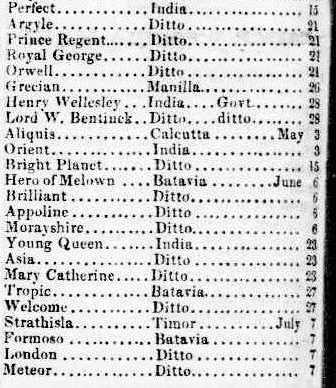
Unfortunately for Jeremiah and Letitia O’Brien and family, they arrived in Sydney at a time of food scarcity, drought and unemployment. The Colony of NSW had been unable to grow enough wheat and corn for the colony’s consumption and due to the Government’s anti free trade stance, conditions were fast approaching famine status. The Government was forced to import emergency food supplies. On May 3 1839, the Aliquis took up a Government tender to bring back rice and flour from Calcutta but was wrecked on the way, in the Torres Straits. The Captain and crew were all saved and taken on to Calcutta. (Commercial Journal and Advertiser , Sat 10 Aug, 1839, p2).
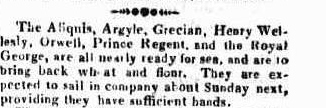
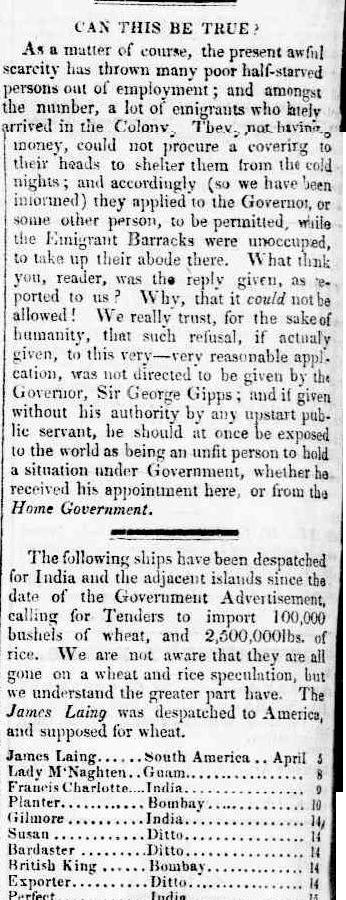
Commercial Journal and Advertiser (Sydney, NSW : 1835 – 1840), Wednesday 24 July 1839, page 2
http://nla.gov.au/nla.news-article226457794

http://nla.gov.au/nla.news-article251536259
The Assisted Immigrants Shipping list for the Aliquis provides more information about the O’Brien family. Unfortunately, the list doesn’t tell us anything about Jeremiah O’Brien’s employment prospects in NSW. Many immigrants on the Aliquis had jobs lined up and their employers’ names and terms of employment were documented in NSW immigration records. Jeremiah may have had employment lined up but his prospects are recorded as ‘unknown’. Jeremiah, an illiterate Catholic farm servant (his father John was a farmer) arrived in Sydney age 31, (born approx 1808) in good health, native to Killaloe, County Clare. His wife Letitia, a needlewoman and day servant was also noted as being in ‘very good health’, Roman Catholic, and able to read and write. According to these same records, Letitia was a native of Vaucluse, County Limerick, daughter to Nicholas Roche of the same place (Architect). We know very little about what happened to Jeremiah after his arrival in Sydney apart from the fact that Jeremiah and Letitia had 2 more children – Anna Matilda in 1842 and Edward in 1845. There are many Jeremiah O’Briens in NSW. I have searched exhaustively in Trove Australian Newspapers and the NSW, QLD and Victorian BDM index to try and match up or eliminate the various Jeremiah O’Briens according to age and family relationships. We know he had a nick name ‘Darby’ like many Jeremiahs in Ireland (from Diarmaid) because he is called ‘Darby O’Brien’ on his daughter Fanny’s Baptism record. What happened to Jeremiah/Darby O’Brien after his arrival in Australia?
 Gardener family history blog