In a previous post I despaired of ever finding our George Gardener – there were so many George Gardeners! But I obtained his death certificate (see below) and saw the few words that were to reveal so much about his life – the words ”6 years in Tasmania, 58 years in NSW” (see death certificate below). Yes! The six years in Tasmania says it all – he’s our second convict (the other one in our family tree is Charles Chadburn). On George’s death certificate his ‘time in Australian Colonies’ amounts to 64 years which means he was only 15 or 16 years of age on arrival in Tasmania. And fortunately there is only one George Gardener of that age who arrived in Tasmania around 1839/1840. Based on the dates on his death certificate, he arrived in NSW in 1846 after completion of his 7 year sentence (of which he had served almost one year before his arrival in Tasmania in 1840). Without this reference to Tasmania on George’s death certificate, I would never have discovered his convict origins.

George Gardiner (15) and his 14 year old partner in crime, Edward Robottom, were indicted for stealing and appeared before the Old Bailey on 8 April,1839, found guilty and sentenced to 7 years transportation to a prison on the Isle of Wight. Parkhurst Prison, on the Isle of Wight, opened in December 1838 to cater for young offenders. The prison offered the boys training and discipline to prepare them for transportation and/or emigration to Australia, whenever a place on a ship became available. See below for Proceedings of the Old Bailey, detailing George’s crime (case no. 1234: Edward Robottom and George Gardiner).

George Gardener/Gardiner and his friend/accomplice Edward Robottom, together with many other boy convicts as young as 11, were transported to Australia on the ship Runnymede, departing London 11 November 1839 and arriving in Van Diemans Land 28 March 1840. Convict records (see description list below) reveal quite a lot about our ancestor George Gardener. We see in this record that George was a Shoemaker (3 years), almost 5 feet tall, with a pale complexion, ‘long’ head, red hair, red eyebrows, blue eyes, hook nose, oval face, high forehead, large mouth and a small chin.
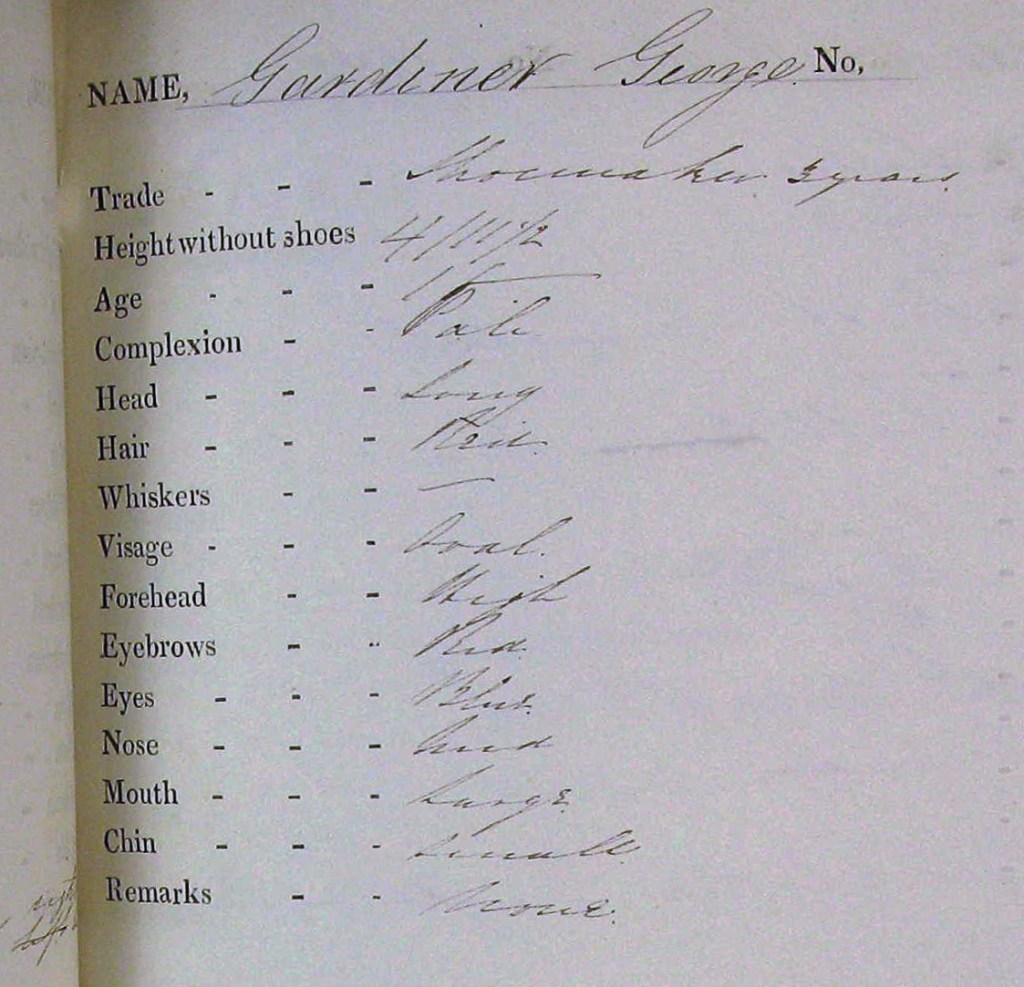
Description List
https://stors.tas.gov.au/CON18-1-1$init=CON18-1-1p210
Appropriation Lists (see example below) of convicts were created to record convicts’ skills/trades in order to best utilise their skills. This list dated 2 April 1840, shortly after George’s arrival in Van Dieman’s Land, records his trade, age, height and native place (London). There was a huge demand for shoemakers at Port Arthur (there was a thriving shoemaking industry and kangaroo tannery from 1835) yet there is no evidence that our George worked in this (his) domain. Perhaps his poor conduct kept him working outside with the convict road gangs?

Appropriation List
https://stors.tas.gov.au/CON27-1-8$init=CON27-1-8P38
2 April 1840
George’s conduct record (below) gives us a tiny insight into the harsh reality of convict life in Van Dieman’s Land. I have managed to decipher most of the handwriting. Here’s a rough transcription with some explanatory details in bold. I have put a question mark where I cannot decipher the writing. George’s date of arrival (28 March 1840) and ship name (Runnymede) appears under his name and beside his Police Number (1490), together with the name of the Court where he was sentenced and convicted (Central Criminal Court & Assizes ie The Old Bailey) as well as the year of conviction: 1839. Transported for Larceny. Gaol report not known (refers to Gaol time on Isle of Wight). Hulk report ? (Hulk report refers to behaviour on floating prison ship awaiting transportation) ? stated that offense stealing a leg of pork Mr Portlock (name of butcher) at Chelsea ? surgeons report good (referring to ship doctor’s report on health and behaviour). May 5 1840: Absent himself without leave – 4 days solitary confinement. Bread & Water (instead of usual convict diet of gruel, cabbage,turnips, potato, salt pork or salt beef), PA (Port Arthur). May 18 1840 absent from the island ? without leave, 20 stripes on the breech. (Boy convicts were lashed on the buttocks) PA/ 27 December 1841, Most disorderly conduct 20 stripes on the breech/ PA/ 2 March 1842. Absent without leave 4 days solitary/ PA/ 11 March 184?/ Point Puer (Boys Prison)/misconduct/5 days solitary confinement/PA/ Jan 15 1844 Glen’y’ pty (Glenorchy working Party?)/ misconduct/14 days Sol?/ B & W (Bread and Water) / T of L (Ticket of Leave) 3 . 5. 1844 – Dec 5/44 ? / Misconduct in falsely stating hazard fire. 2 months hard labour TL (Ticket of Leave) susp’d (suspended)/ SP?/ Survey p? (party) going Hobart. Vide L.G Decs (see/refer to Lt Governor’s Decisions – these documents have not survived). 6/12/1844 – 3 Jan 1845 T of Leave / neglect of work ? & sentence to hard labour ? 2 months ? to be served a/to (assigned to) a party in the interior/? /? Glenorchy (road gang?) Vide LG decisions 3/1/1845/ 19 January 1845 Extend sentence of ? 3 days of solitary confinement /? / Free Certificate 1845 -1846
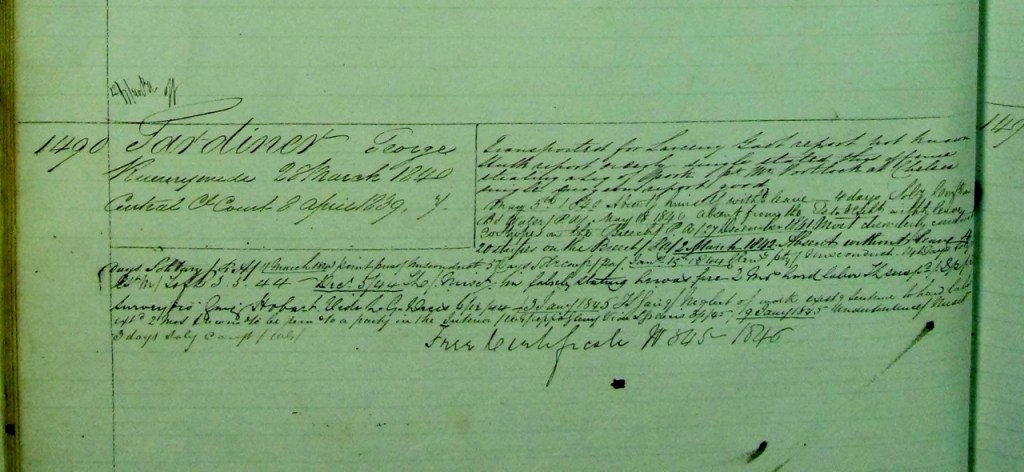
https://stors.tas.gov.au/CON31-1-17$init=CON31-1-17p62
The date that George was granted his certificate of freedom is not very clear in his conduct record (above) however the document below (see 1490 Gardener, George) records the Certificate of Freedom date: 14/4/1846.

Ancestry.com. Tasmania, Australia, Convict Court and Selected Records, 1800-1899 [database on-line]. Provo, UT, USA: Ancestry.com Operations, Inc., 2015.
Original data: Tasmanian Colonial Convict, Passenger and Land Records. Various collections (30 series). Tasmanian Archive and Heritage Office, Hobart, Tasmania.
Now that we know that George’s freedom was certified on 14 April 1846 (he may not have received the paperwork immediately, if at all) we can hazard a guess as to his departure from Van Dieman’s Land. We know George went to New South Wales and it’s possible that he left the same year as he was granted his freedom, at the end of his sentence. There’s a George Gardener listed on the passenger list below (last name in the list on the right hand side: ‘Geo Gardiner’ that could fit the bill, leaving from Hobart for Sydney 17 October 1846 on the ship ‘Eliza Ann’. It is interesting to note the presence of a ‘Peter Casey’ on this passenger list – probably the same Peter Casey who was transported on the ‘Runnymede’ with George Gardener in 1839. It appears that George Gardener’s partner in crime, Edward Robottom, remained in Tasmania, applying to marry convict Ann Page (vessel Woodbridge) in 1848.

https://stors.tas.gov.au/NI/551761
17 Oct 1846
Departure Hobart to Sydney, Ship ‘Eliza Ann ‘
Steerage
I need a lot of help with this next clue please. I found a convict record for George Gardener that provides a locality in London (see mysterious writing in document below, beside 1490 Gardiner, Geo, under the column ‘Native Place’). I asked the very helpful people in the Facebook history group ‘Genealogy My Ancestors Came to Australia’ who suggested it could be ‘Cow Cross’, (near present day Farringdon Station in Clerkenwell) a route for droving cattle to a cow market and precinct for associated trades in knackery, bones, butchery, and leather works, established since Medieval times. The poorest of the poor lived in tenements in the alleyways alongside, above and behind these smelly industries, in an area renown for violent crime and theft. Our convict George Gardener may have lived and worked as a shoemaker in this area, near the slaughterhouse and tannery.
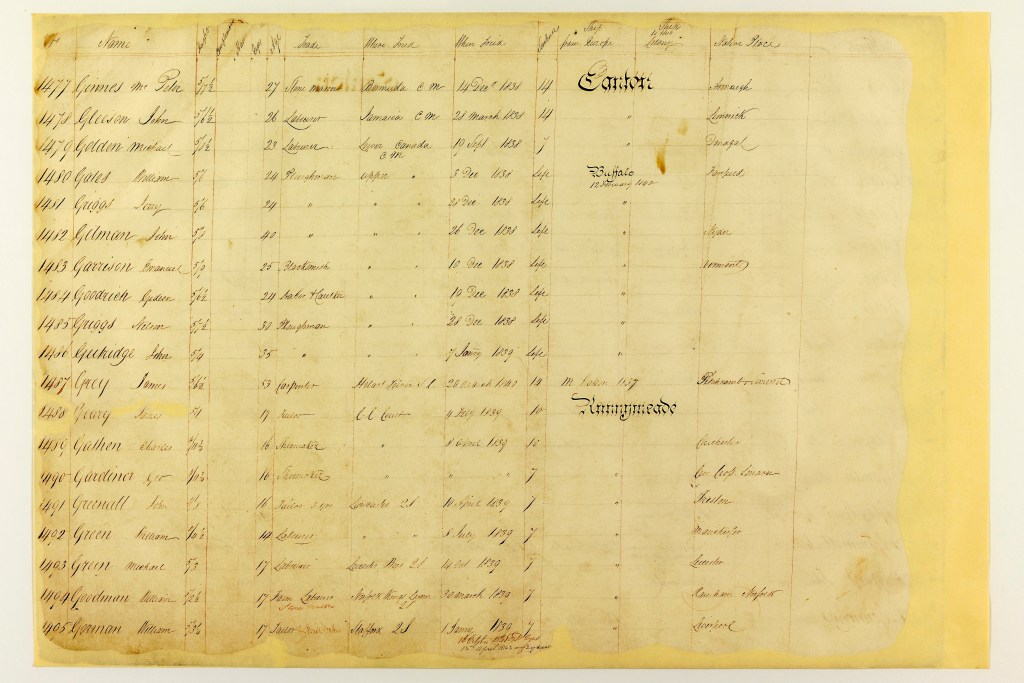
Alphabetical Registers of Male Convicts
https://stors.tas.gov.au/CON23-1-2$init=CON23-1-2-P040
I have enlarged (from the document above) the problem words (see below). What do you think? Could it be Cow Cross? I have started searching for George Gardener’s origins in London – all I know is the sparse information on his marriage certificate (see post on Frances O’Brien), i.e he came from London, his father’s name (George Gardener) and mother’s name (Ann Webb). I have searched UK marriage records (for his parents) baptism and census records but have not found anything to confirm his family origins. As yet, Dad’s DNA test has not provided any further clues.

George Gardener’s life in Somerton
I don’t know what George Gardener senior did after he left Tasmania and before he selected land in Somerton around 1857 ( a period of around 10 years). He may have married or had children in this time, although I have not found evidence of this.


 Gardener family history blog